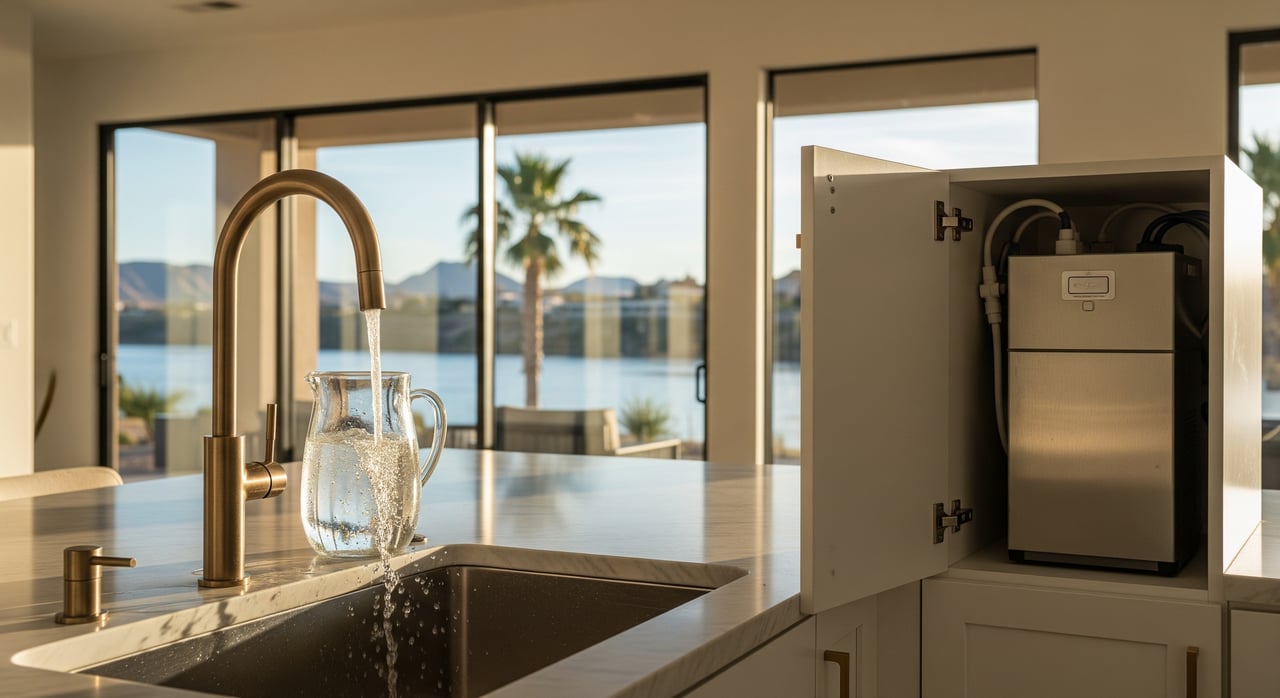
Tired of white spots on shower doors, cloudy glasses, or crunchy towels at your Los Lagos home? You’re not imagining it. Hard water is common along the Colorado River corridor, and it shows up fast on fixtures and appliances. In this guide, you’ll learn how to confirm hardness at your address, compare the best treatment options, understand costs, and avoid common mistakes. Let’s dive in.
Hard water in Los Lagos, explained
Bullhead City supplies water from the Colorado River and local wells, and you can review recent data on the city’s utilities pages. Start with the Bullhead City utilities water quality page for Consumer Confidence Reports and well reports.
Several water-treatment sources report Bullhead City hardness around 615 mg/L, or roughly 36 gpg. Treat these as third-party estimates and verify with the city or your own test. By USGS hardness classification, that level falls in the very hard range.
Hardness is a nuisance issue, not a federally regulated health contaminant. The USGS notes hardness is not a federal health standard, though some people notice dry skin or hair.
Signs and impacts you’ll notice
- White or gray scale on faucets, shower glass, and tile.
- Soap scum, dull laundry, and reduced lather from shampoos and soaps.
- Spotted dishes or cloudy glassware after washing.
- Scale buildup inside water heaters, clogged showerheads, and extra wear on appliances over time.
How to confirm your water hardness
- Check your system’s reports. Review the latest CCR on the city site and look up your public water system record in ADEQ Drinking Water Watch. If hardness is not listed, call the utility for current lab numbers.
- Do a quick test. Use a simple test strip for a fast gpg or ppm reading.
- Get a lab test for decisions. If you’re buying a home or investing in equipment, order a lab test that measures hardness as CaCO3 and related items like iron, manganese, and TDS.
Best hard water fixes for Los Lagos homes
Salt-based ion-exchange softeners
These whole-house systems swap calcium and magnesium for sodium or potassium. Look for systems that meet NSF/ANSI standards for performance.
- Benefits: Reliable hardness reduction to near zero, better soap performance, less scale in plumbing and appliances.
- Tradeoffs: You’ll refill salt or potassium chloride, connect a drain for brine, and plan for routine service. Typical ownership costs run in the low hundreds per year.
- Sodium in softened water: The sodium added depends on your incoming hardness and settings. For low-sodium drinking water, you can bypass the kitchen cold tap, use potassium chloride, or add a small RO system. See how sodium added depends on your hardness.
Salt-free conditioners (TAC)
Template Assisted Crystallization turns hardness minerals into tiny crystals that are less likely to stick to surfaces. It does not remove minerals, so water won’t feel “soft,” but it can reduce scale on plumbing and heating elements. Independent reviews of alternatives are summarized in the Water Research Foundation evaluation of alternatives.
- Benefits: No salt, no brine discharge, low maintenance, and no added sodium.
- Limitations: Performance varies with water chemistry. It can reduce scale formation but will not change soap behavior the way a softener does.
Point-of-use reverse osmosis (RO)
Under-sink RO removes many dissolved solids for drinking and cooking. It is not usually cost-effective for whole-house treatment. Many homeowners pair RO for the kitchen with either a softener or TAC for the whole house.
Magnetic or electronic descalers
These devices try to influence scale formation with electric or magnetic fields. Results vary. If you try one, measure before and after and watch your shower glass, faucets, and water heater performance over time.
Smart hybrid setups
- Soften hot water only to protect the water heater, dishwasher, and laundry.
- Use TAC at the entry for scale control and RO at the kitchen for taste.
- Install a softener for whole-house comfort and route a dedicated cold tap around it for low-sodium drinking water.
Costs, sizing, and maintenance
- Installed cost ranges: Many whole-house softeners fall between $500 and $3,000 installed, with higher prices for large or twin-tank systems. See typical installed cost ranges.
- Salt-free TAC systems vary widely, often $300 to $4,000 installed depending on capacity and brand.
- Point-of-use RO systems commonly run a few hundred to around $1,800.
- Electronic descalers are often $160 to $600 and are usually DIY.
Sizing a softener starts with your hardness in gpg and your household’s daily water use. Multiply gallons per day by hardness to estimate daily grains to remove, then choose a capacity that regenerates every few days. Always size from a fresh test, not a citywide average.
Plan for salt or potassium refills and periodic service on softeners, media replacement on TAC units, and filter changes on RO. Budget roughly $100 to $300 per year for a typical salt-based softener, depending on water use and hardness.
Local notes for Los Lagos homeowners
- Check discharge rules. Before installing a salt-based system, confirm whether brine discharge to the sewer is allowed and if any local permits apply. The city utilities and ADEQ can guide you.
- HOA considerations. If your HOA restricts exterior tanks or visible equipment, confirm placement before you buy.
- Resale tip. Keep your water test, equipment specs, and service records. Buyers often ask for them during inspections.
How to choose the right pro
- Require on-site testing and a written plan based on measured hardness, TDS, iron, and your actual water use.
- Ask for certifications, insurance, and references. Products should list NSF/ANSI standards, and installers familiar with WQA standards are a plus. Use the WQA directory of certified professionals.
- Get at least two quotes that detail capacity, salt or water use, maintenance and media replacement schedules, and warranties.
Your next steps
- Test your water. Start with a strip, then get a lab test if you’re buying or planning a new system. Also review your CCR.
- Set priorities. Decide if your top goal is scale protection, soap feel, or avoiding added sodium. That choice narrows the tech.
- Get site-specific quotes. Ask for sizing based on your hardness and gallons per day, plus maintenance schedules and warranties.
- If you choose a salt system, confirm local discharge rules and plan any bypass for drinking water.
If you’re weighing hard water solutions before a purchase or sale in Los Lagos, let a local expert help you connect the dots between the home, the HOA, and the utility. For neighborhood insights and a smooth real estate plan, reach out to Jeff Curti.
FAQs
What does “very hard” water mean in Bullhead City?
- By the USGS hardness classification, water above 180 mg/L as CaCO3 is very hard; third-party sources report Bullhead City around 615 mg/L, which you should verify with a test or the city CCR.
Is hard water a health concern in Los Lagos?
- Hardness is considered a nuisance issue and the USGS notes it is not a federal health standard; many homeowners treat it to protect appliances and improve soap performance.
How can I check hardness for a Los Lagos property I’m buying?
- Review the Bullhead City utilities water quality page and confirm with a quick strip test, then order a lab test for purchase decisions or equipment sizing.
What if I want soft water but low sodium for drinking?
- Use potassium chloride in your softener, route the kitchen cold tap around the softener, or add a small RO unit at the sink to remove dissolved minerals.
How much should I budget for a whole-house softener?
- Many homes see $500 to $3,000 installed for standard systems, with annual operating costs in the low hundreds and higher prices for large-capacity or twin-tank setups.